
Everyone has an opinion on subdividing. Almost nobody has the numbers. So we went through more than 7,000 subdivision applications across six Queensland councils, and read around 600 Brisbane subdivision plans in full, to answer the questions people actually ask before they split a block. Everything below is from public council development records over the last three years. None of it is advice, and the rules vary by council and zone, so always confirm your own block with a town planner.
Councils almost never say no. The real "no" is the withdrawal.
| Outcome | Rate | Applications | What it means |
|---|---|---|---|
| Approved | 96.9% | 6,556 | Council gave the green light |
| Withdrawn | 2.7% | 186 | The real danger zone. The applicant pulled out, usually after costs or conditions made it unviable |
| Refused | 0.4% | 26 | Outright rejected. Rare |
Read the last two rows together. Applicants withdraw about seven times more often than they are refused. Councils rarely reject a subdivision outright. The project dies a quieter death: the applicant pulls out, usually after the council's information request reveals that extra engineering, drainage or infrastructure conditions make the costings stop working. The real risk is not rejection. It is getting halfway in and finding the block costs more to split than the result is worth.
Most subdivision is one block into two
| Split | Subdivisions | Share |
|---|---|---|
| 1 into 2 | 394 | 64% |
| 1 into 3 | 68 | 11% |
| 1 into 4 to 5 | 57 | 9% |
| 6 to 10 | 34 | 6% |
| 11 or more | 61 | 10% |
People picture developers and estates. The data says otherwise. 64% of subdivisions create just two lots, one block split in half. Larger multi-lot estates exist, but they are the exception. Subdivision here is overwhelmingly an ordinary owner splitting one big block, not a developer building a street.
How big does your block need to be, and what do the new lots become?
The pattern is strikingly consistent: an ~810 m² block becomes two ~400 m² lots. For a standard two-lot split in Brisbane's low-density areas, you generally need around 600 m² to even qualify, with the smallest approved splits sitting right at that mark. Here is where the new lots land:
| New lot size | New lots | Share |
|---|---|---|
| Under 300 m² | 125 | 9% |
| 300 to 399 m² | 520 | 37% |
| 400 to 499 m² | 531 | 38% |
| 500 to 599 m² | 116 | 8% |
| 600 m² or more | 113 | 8% |
The 400 m² lot is the modern Brisbane subdivision product. The classic ~810 m² post-war block is the raw material: big enough to qualify, and worth enough to make splitting it pay.
Your lot size is not your buildable land
Not every block can split side by side. A clean two-lot split down the middle needs enough street frontage for both new lots, around 15 m each in Brisbane, so roughly 30 m in total. Plenty of blocks are the wrong shape for that: long from front to back but only 15 to 20 m wide. Splitting one of those down the middle would leave two lots too skinny to meet the minimum frontage. So the usual move is to carve a lot out the back instead, a "battle-axe" lot that reaches the street only by a long, narrow access handle running past the front house. One in five subdivisions creates one. You can eyeball a block's width, frontage and shape against the cadastre on QLD Globe before you commission a survey.
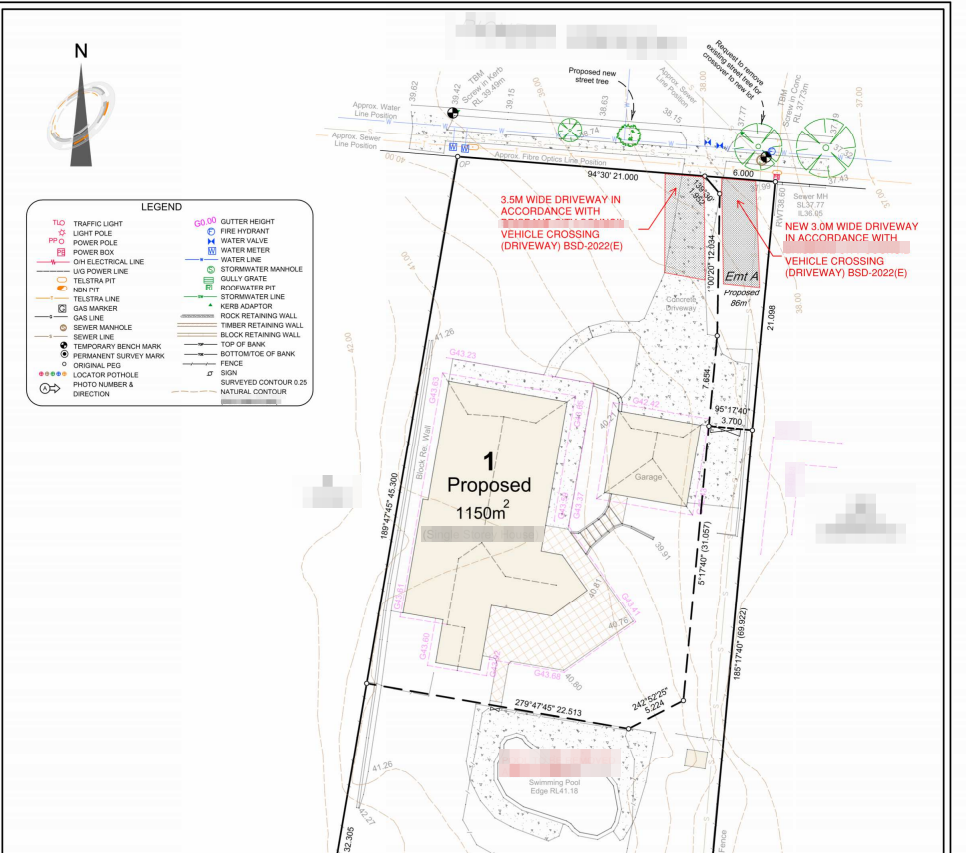
When a block is split this way, the access to the rear lot has to cross someone's land, and that someone is usually the front lot. The result is an access easement: a strip, typically around 4 m wide, running down the side of the front block to the lot behind.
Here is the part buyers miss. When that access strip sits on the front lot's title, it pads the front lot's stated area, so a block advertised as "600 m²" can look bigger and more appealing than it really is. You cannot build on the strip, you cannot fence it off, and landscaping it adds nothing to your own value, because the land is reserved for the rear lot's access, not yours. Part of what you are buying is effectively someone else's driveway that you happen to own.
Looking at a freshly split lot and wondering how much of that block you can actually use? Check the easements and overlays on the exact address, free:
Drainage and sewer easements work the same way: a drainage easement is typically about 1.5 m wide and a sewer easement about 1 m, each running across your land with a public pipe in it that you generally cannot build over. You can sometimes apply for a build-over approval, but it is conditional, it can require the structure to be removable so the pipe stays accessible, and it is never guaranteed. So when you see a fresh lot's size, the real question is not the number on the title. It is how much of it you can actually use.
What else shows up, and how often
| Feature | Share of subdivisions |
|---|---|
| Easement | 52% |
| Retaining wall | 37% |
| Cut and fill earthworks | 28% |
| Shared driveway or crossover | 27% |
| Battle-axe rear lot | 21% |
| Protected tree | 14% |
| Land lost to road widening | 10% |
An easement sits on about half of all newly subdivided lots, the most common encumbrance by far. A retaining wall on over a third (and if your building and pest report flags failing walls or poor drainage, read what that actually costs you in Queensland first). None of these kills a subdivision on its own. Together, they are why that withdrawal rate exists. A block that looked like an easy split turns marginal once two or three of them stack up.
Where it is happening
The Brisbane suburbs splitting blocks most often are Acacia Ridge, Coorparoo, Zillmere, Salisbury, Aspley, Kenmore, Indooroopilly, Sunnybank, Tarragindi, Carina, Camp Hill and Morningside. Middle-ring suburbs with large post-war blocks: big enough to split, valuable enough to make it worth doing.
How to check your own block
All of this is public, so you can pull it yourself. The catch is it lives in four different places: lot size and easements on the state cadastral map, nearby approvals on your council's development tracker, the minimum lot size in the planning scheme, and the easement detail on the registered survey plan. It is an afternoon of tab-juggling, and you have to know what each one is telling you.
Or look up your address in Property X-Ray. We pull the lot size and dimensions, the easements on your block and the neighbours', the zoning, what is approved nearby, and whether the block looks subdividable, into one report, in seconds.
The honest answer
- If you own a big block and are thinking of splitting it, the odds of approval are excellent, but the withdrawal rate is the warning. Price the easements, retaining and earthworks before you lodge, not after.
- If you are buying a new subdivided lot, look past the lot size to the buildable area. Check for an access easement, a drainage easement or a battle-axe handle before you fall for the number on the title.
- If you are hunting for blocks with upside, the 600 m² minimum and 15 m frontage rule out a lot of stock. The clean candidates are the ~810 m² post-war blocks in the middle-ring suburbs above.
Methodology
- Outcomes: public council development records, subdivision applications decided 2023 onward, across Brisbane, Ipswich, Logan, Moreton Bay, Redland and Toowoomba.
- Lot counts, sizes and features: around 610 Brisbane subdivision plans read in full, 2023 onward. Parent block sizes joined to the Queensland cadastre; new lot sizes from the approved plans.
- All figures are aggregates (medians and frequencies over hundreds of records). Individual per-plan figures from plan free-text are not cited, and no cost-to-subdivide figures are claimed, because reliable cost data is not available in the source.
Companion reads: which streets see the most development applications, Brisbane's worst flood-risk streets, the suburbs where recorded crime is falling, and all our Queensland suburb research.
Want to know whether your own block can be split, or what a new lot you are eyeing really gives you? Look it up in Property X-Ray below.